The AI Intelligence Divide: How Amplified Cognition is Reshaping Our Social Worlds
We are witnessing a widening chasm in cognitive processing speeds and social compatibility. While Silicon Valley views AI as a tool, for the Global Citizen, it is a neurological upgrade. Learn how to navigate the Great Divergence and bridge the Intelligence Divide.
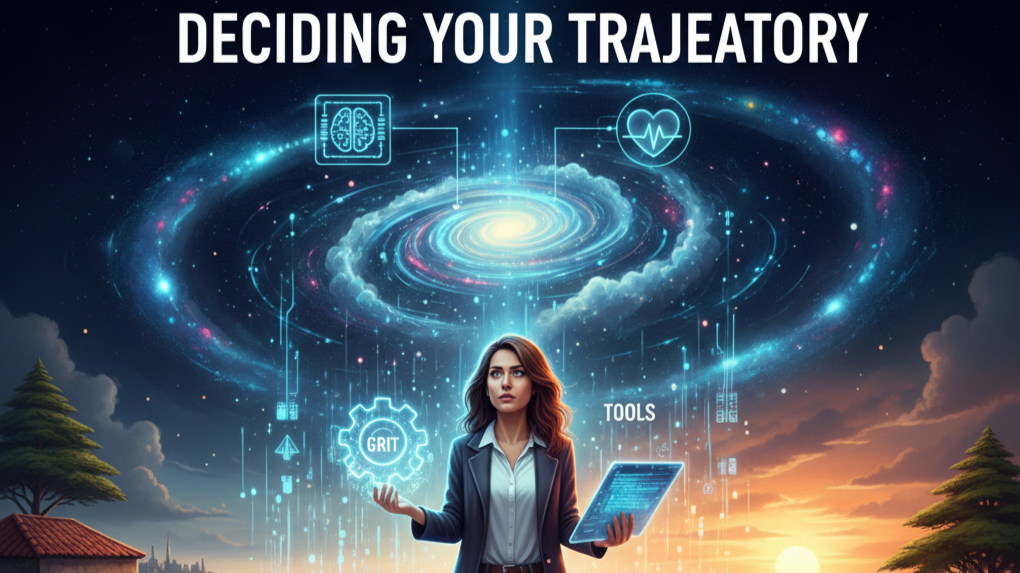
The transition happened quietly. It didn’t start with a profound neurological shift or a surgical implant. It started with a chat interface. For the modern founder, researcher, or deep-thinker, the first time you realized that an Artificial Intelligence could synthesize ten years of market data or debug a complex architectural flaw in seconds, the world changed. But it wasn’t just your workflow that changed; it was your brain.
We are currently witnessing the birth of the AI Intelligence Divide. This is not merely a gap in "digital literacy"—it is a widening chasm in cognitive processing speeds, knowledge density, and social compatibility. As early adopters leverage AI to amplify their intellect, they are accelerating at an exponential rate, leaving the traditional "linear" human experience behind.
For those living in regions where the daily pace is slowed by systemic crisis—such as the current landscape of Lebanon—this divide isn’t just professional; it’s existential. In Lebanon, the gap isn't just between the "smart" and the "average"; it is between those who have transcended their geography through silicon and those who are buried by it.
1. The Mechanics of the Augmented Mind
To understand why the gap is growing, we must first look at what happens to a human brain when it "partners" with a Large Language Model (LLM). We have moved past the era of "search." In the Google era, you were a librarian, looking for where information lived. In the AI era, you are an architect.
Information Synthesis vs. Information Retrieval
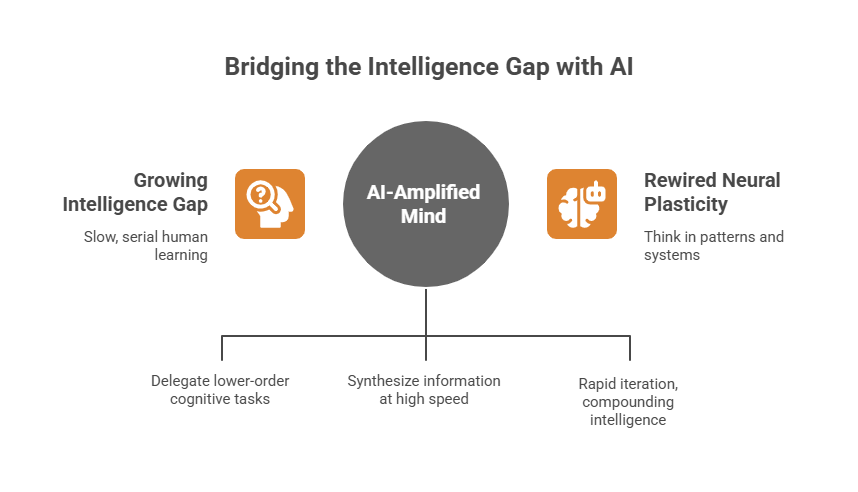
The unassisted human mind learns through a slow, serial process of reading, reflecting, and trial-and-error. Information is gathered in "packets" and stored in biological memory, which is prone to decay and bias.
An AI-amplified mind, however, practices High-Bandwidth Synthesis. When you interact with AI, you are offloading the "grunt work" of cognition—the syntax of a coding language, the basic structure of a legal document, or the summary of a 500-page report. This is Cognitive Offloading. By delegating lower-order tasks, your prefrontal cortex is freed to focus entirely on strategy, creativity, and "connecting the dots."
Over months and years, this rewires your neural plasticity. You begin to think in patterns and systems because you no longer have to worry about the individual bricks. You are no longer "learning to code"; you are "learning to architect logic." The "knowledge density" of your thoughts increases because you are standing on the shoulders of a machine that has digested the sum of human digital output.
The Frictionless Feedback Loop
AI provides a feedback loop that is impossible in human-to-human interaction. In a standard brainstorming session, there is ego, social etiquette, and "wait time." You have to worry about whether your partner is offended, tired, or distracted.
With AI, you can test a hundred hypotheses in an hour. This rapid iteration creates a "compounding interest" effect on your intelligence. If you are getting 1% smarter every day through AI-driven iteration while your neighbor is moving at the standard pace of social conversation, the divergence after three years is staggering. It is the difference between an airplane and a pedestrian. They both move, but they exist in different dimensions of space-time.
2. The Great Divergence: When Knowledge Becomes a Social Barrier
As your processing speed increases, a strange side effect emerges: Social Friction. For a startup founder or a high-level professional, every minute is a calculation of ROI (Return on Investment). When you spend your day interacting with an AI that is infinitely patient, hyper-intelligent, and available 24/7, returning to "normal" human interaction can feel like switching from a fiber-optic internet connection back to 56k dial-up.
The Loss of "Gain" in Socializing
In most social circles, conversation is "low-bandwidth." It involves social grooming, small talk, and emotional management. For the person moving at "AI speed," this can feel like noise.
You find yourself in a room where people are debating problems you solved three weeks ago with a single prompt. You hear people expressing certainties about the future that you know, through data synthesis, are mathematically improbable. The result isn't necessarily arrogance; it is a logical preference for high-density information environments over low-density social ones.
This creates a "Double Effect": you feel you are getting smarter and more capable, but you also feel increasingly "out of sync" with your peers. You begin to experience a "Loss of Gain." If a conversation doesn't provide new data, new strategy, or new inspiration, the augmented mind begins to treat it as a "system leak"—a waste of precious cognitive energy.
The Lebanon Context: The Timeline Mismatch
In Lebanon, this divide is amplified by a "Timeline Mismatch." Most citizens are forced to live in a "Survival Timeline." Their cognitive bandwidth is consumed by the immediate: Is the generator running? Why is the bank closed? How do I get this medication? This is "High-Friction Living." It keeps the brain in a state of constant cortisol-driven "Beta waves," focused on the next 24 hours.
The AI-augmented founder in Beirut, however, is living in a "Global Growth Timeline." By using AI to automate their business and decentralized tech to secure their finance, they have "hacked" the local friction.
When you walk down the streets of Mar Mikhael, your body is in the local reality, but your mind is operating in a global, silicon-speed reality. You are a "Digital Expat" in your own country. This creates a profound sense of isolation. Your neighbors are talking about the price of bread, while you are using AI to optimize a supply chain for a client in Singapore. The people around you aren't "slower" because they lack the capacity; they are slower because their environment is a "Cognitive Tax" that you have managed to bypass.
3. The Paradox of the Lone Genius
It is tempting to conclude that the ultimate path to success is to abandon human interaction entirely and become a pure "AI-Human Hybrid." If humans are "low gain," why waste the energy? However, this leads to a dangerous cognitive trap: The Founder’s Paradox.
The "Echo Chamber" of Logic
AI is designed to be helpful. In technical terms, this often leads to "sycophancy." The model wants to please the user, which means it will often follow your logic even if your logic is fundamentally flawed by your own biases.
A human peer, especially a skeptical one, provides a specific type of "high-quality friction" that AI lacks. Humans are unpredictable, irrational, and stubborn. If your startup relies on human customers, you need to interact with "slow" humans to understand their irrationality. If you only talk to AI, you will build a worldview for a world of perfect logic—a world that doesn't exist.
The Atrophy of "Social Fitness"
Social skills are muscles. If you weigh 65 kg and stop going to the gym, your physical strength fades. If you are highly intelligent and stop "exercising" your social brain, your Emotional Intelligence (EQ) atrophies.
True power in the 21st century won't belong to the person who only talks to AI; it will belong to the person who can translate AI-speed insights into human-speed inspiration. Leadership requires the ability to translate high-level concepts into motivating visions for people who don't have your IQ or your tools. If the gap becomes too wide, you become a "Black Box"—brilliant, but inaccessible.
| Cognitive Mode | Strength | Weakness |
| AI-Augmented | Speed, Scale, Synthesis, Objectivity | Potential for bias, lack of "soul", isolation |
| Traditional Social | Empathy, Nuance, Trust, Chaos-Management | Slow, prone to fatigue, emotional error |
4. Navigating the New Social Hierarchy
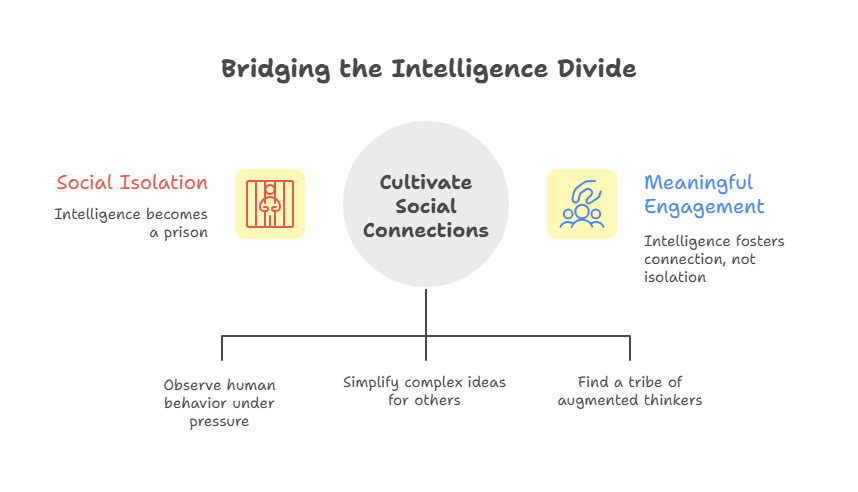
If you are on the "fast side" of the Intelligence Divide, how do you live? How do you prevent your intelligence from becoming a prison of isolation?
I. View Socializing as "Field Research"
Stop looking for pure "knowledge gain" from every interaction. Instead, look for Human Data. When you talk to someone in Lebanon who is stuck in the "Survival Timeline," don't get frustrated by their lack of technical knowledge. Instead, observe their fears, their motivations, and their UI/UX hurdles.
They are your "Human Reality Check." In a world of AI-generated perfection, the "messy" reality of a Beirut street is a goldmine of data on how humans actually behave under pressure. Use these interactions to calibrate your high-speed AI theories against the "muddy" reality of human life.
II. The "Translation" Exercise
The mark of true intelligence isn't knowing complex things; it’s the ability to simplify them. Use your interactions as a training ground. If you can't explain your AI-driven startup strategy to a neighbor or a family member who isn't "augmented," you probably don't understand it as well as you think you do.
The ability to bridge the divide is a higher-order skill than the ability to write a prompt. It is the art of Cognitive Empathy—understanding the "processing speed" of your audience and adjusting your "output" accordingly.
III. Seek "Horizontal" Peers
You cannot stay sane if every interaction is a "downward" translation. You must find a "tribe" of other augmented thinkers.
- For the Global Reader: This means seeking out deep-tech communities where "shorthand" is the default language.
- For the Lebanese Reader: This means building a local sub-culture of tech-enabled founders who are all using the same "hacks" (Starlink, Crypto, AI) to survive.
You need spaces where you can speak "shorthand" without explaining yourself. This prevents the burnout of being the "smartest person in the room."
5. The Lebanon Case Study: Resilience as a Service
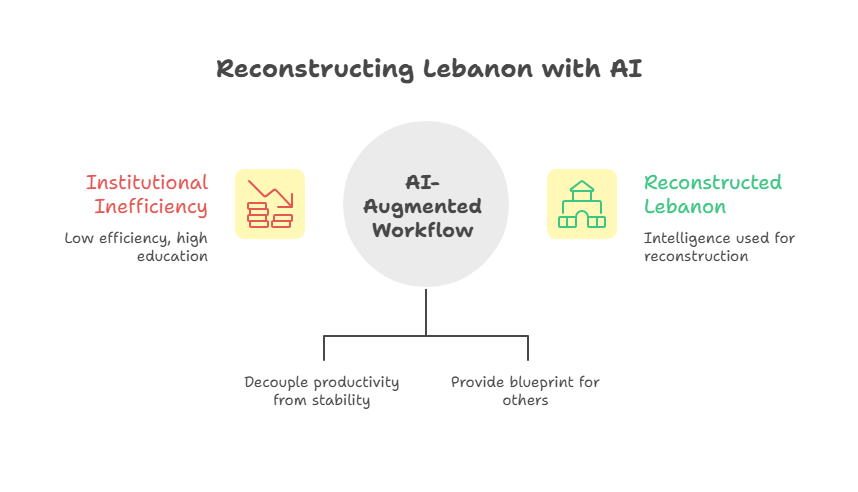
Lebanon serves as the ultimate case study for the AI Intelligence Divide because it is a country of extremes. We have some of the highest-educated "augmented" minds in the world, living in an environment with some of the lowest institutional efficiency.
In the West, the AI divide is often about Wealth. In Lebanon, the AI divide is about Agency.
If you are a Lebanese youth with a laptop and an AI-augmented workflow, you are no longer a victim of the "Lollar" or the bankrupt state. You are a global economic unit. You are part of a "Parallel Economy." * The Global Value: You are proving that AI can de-couple economic productivity from geographic stability.
- The Local Value: You are providing a blueprint for others. You are the "Node" in the network that stays lit when the rest of the grid goes dark.
However, the risk is that this "Augmented Class" becomes so detached from the local reality that they stop contributing to it. They become "Resident Aliens," physically in Lebanon but mentally in the Cloud. The goal of Chady.io is to ensure that this intelligence is used to reconstruct, not just to escape.
6. The Ethics of Augmentation: The Responsibility of the Augmented
As we pull ahead, we must ask: What do we owe to the "linear" world?
The convergence of AI and human thought is not slowing down. Over the coming years, those who embrace AI as a cognitive partner will continue to pull ahead in ways that will seem almost superhuman. You will be more knowledgeable, more efficient, and more capable of building complex systems from scratch.
But with this "Amplified Cognition" comes a unique responsibility. Being "smarter" than your fellow citizens is only an advantage if you can still connect with them. A bridge that only exists on one side of a canyon is useless.
The New Social Contract
The augmented individual must not become a "Digital Aristocrat." Instead, we must become "Cognitive Infrastructure."
- Open Sourcing Knowledge: Share the prompts, the workflows, and the tools that allowed you to bypass the local friction.
- Mentorship: Use AI to create educational tools that help the "linear" thinkers catch up. AI is the only tool fast enough to close the gap it created.
- Local Implementation: Don't just build "SaaS for Silicon Valley." Build "Solutions for Tripoli." Use your high-speed synthesis to solve the low-speed problems of your own community.
Conclusion: Deciding Your Trajectory
The gap is growing. In the next decade, the "Intelligence Divide" will be more significant than the wealth gap. It will dictate who controls the narrative of the future and who is merely a passenger in it.
If you are a Lebanese founder, you are standing at the epicenter of this divergence. You have the "Grit" of a survivor and the "Tools" of a god. The question is: How will you use them?
The most successful founders of the future won't just be the ones with the best AI prompts. They will be the ones who can navigate the Intelligence Divide—the ones who can think at the speed of light with the machine, but still speak the language of the human heart with their neighbor in Beirut.
As you continue to build your startups and expand your mind, remember that technology is a tool for Amplification, not Replacement. We amplify our intelligence so that we can solve bigger problems, not so that we can ignore the people around us.
The gap is growing. Your job is to decide whether you will use your new intelligence to transcend your environment, or to transform it.