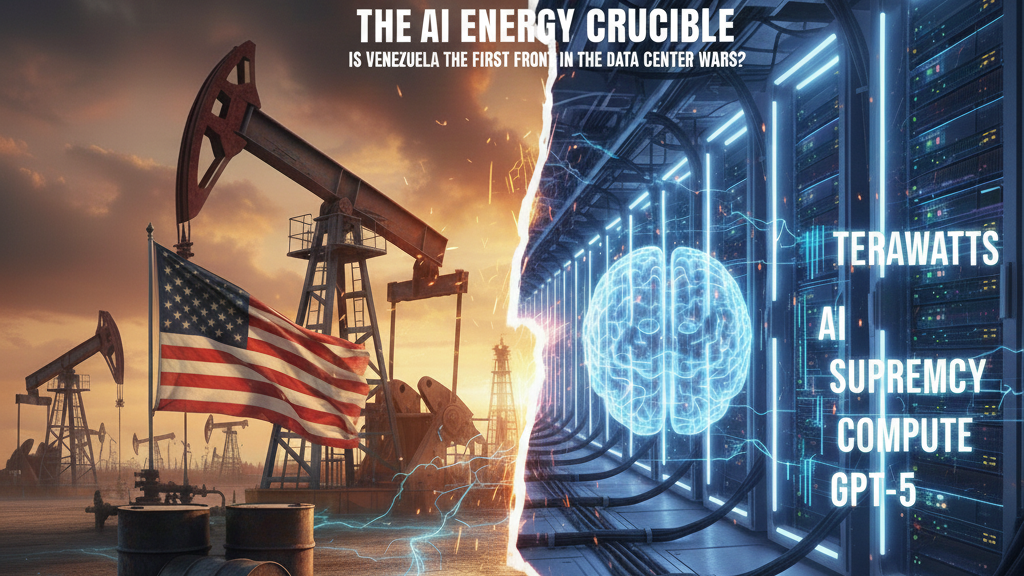
The AI Energy Crucible: Is Venezuela the First Front in the Data Center Wars?
January 4, 2026
The first week of 2026 has been defined by a single, jarring image: the American flag over Caracas. While official headlines speak of “democracy restoration” and “Operation Absolute Resolve,” a quieter, more tectonic shift is occurring under the surface of the global economy.
This isn’t the oil war of your father’s generation. It isn’t about keeping gas prices low at the pump in Ohio. It is a war for watts.
We have officially entered the era of the Data Center Wars. The ultimate prize in 2026 is no longer just the fuel to move cars, but the baseload electricity required to move minds. As the U.S. moves to "run" Venezuela following the capture of the Maduro regime yesterday, the "Venezuela Hypothesis" has moved from speculation to reality: AI dominance requires energy abundance, and the U.S. just secured the world’s largest battery.
The Ghost of January 3rd: A New Kind of Strike
For those of us in the Middle East, the timing of this intervention is impossible to ignore. Yesterday, January 3rd, marked the sixth anniversary of the drone strike that killed Qasem Soleimani. While the 2020 strike was a surgical hit on a military commander, the 2026 operation in Caracas is a surgical hit on a global resource node.
The symbolism is heavy. In 2020, the U.S. sent a message about regional kinetic power. In 2026, by dismantling a key Iranian and Chinese ally in the Western Hemisphere on this specific anniversary, the U.S. has signaled a shift in the "Axis of Resistance." The battleground has moved from the streets of Baghdad to the energy grids that will power the next century’s most important technology. We are witnessing the transition from the "War on Terror" to the "War for Training Data and Power."
Part 1: The AI Energy Black Hole
To understand why Caracas matters to Silicon Valley, you must understand the sheer, gluttonous scale of AI’s appetite. In early 2025, the industry hit a physical wall. We had the chips, but we didn't have the juice to plug them in.
The Staggering Scale of Consumption
As of today, the "compute-bound" era of AI is dead. We are now "power-bound."
- The Cost of a Prompt: A single query to a reasoning model like OpenAI’s latest release consumes roughly 10x the electricity of a legacy Google search.
- The Global Footprint: Data centers are projected to consume over 1,000 TWh by the end of this year. In the U.S. alone, they are pushing toward 7% of total grid capacity, leading to "AI brownouts" in Virginia and Texas.
- The 24/7 Imperative: High-density AI "factories" cannot run on intermittent wind and solar alone. They require baseload power—steady, unblinking energy. This has forced a desperate return to natural gas—the very resource Venezuela holds in abundance.
Part 2: Venezuela’s Untapped Potential
Why Venezuela? Because it sits on a geological miracle that the AI age desperately needs. Venezuela holds 303 billion barrels of proven oil reserves, but for the AI strategist, the real prize is the 5.5 trillion cubic meters of natural gas.
Natural gas is the "bridge fuel" of the AI era. It is the fastest way to spin up the massive turbines needed for the 5-gigawatt data center campuses currently under construction. By securing Venezuela, the U.S. is "near-shoring" its energy security, ensuring that the next generation of LLMs is trained on American-controlled fuel.
Part 3: The "Denial" Strategy: Cutting Off Rivals
In a race, you win by running faster or by making sure your opponent runs out of breath.
China’s AI ambitions are massive, but their energy security is their Achilles' heel. By asserting control over Venezuelan resources, the U.S. isn't just gaining fuel; it is denying it to Beijing.
- Increasing Costs: Forcing rivals to rely on more expensive or less reliable energy sources increases their "compute tax."
- Strategic Deprivation: In the 20th century, we denied enemies steel. In 2026, we deny them the megawatt-hours required to train a frontier model.
Conclusion: The Unseen War
The intervention in Venezuela, launched on the anniversary of the Soleimani strike, is the first "kinetic" move in a war that has been brewing for years. We are no longer debating the ethics of AI in a vacuum; we are fighting over the physical atoms required to make it run.
Whether you are a developer in San Francisco or a founder in Beirut, your success is no longer just about your code—it’s about your connection to the grid.
The lights are staying on in the West, but at a massive geopolitical cost. For those of us in the "constrained" world, our challenge is to prove that intelligence can flourish even when the watts are scarce.
What do you think?
Is the "AI Energy War" the real driver behind the new Monroe Doctrine, or are we simply seeing history repeat itself with a new label?