Beyond Resolutions: Architecting Your 2026 with AI for Exponential Growth
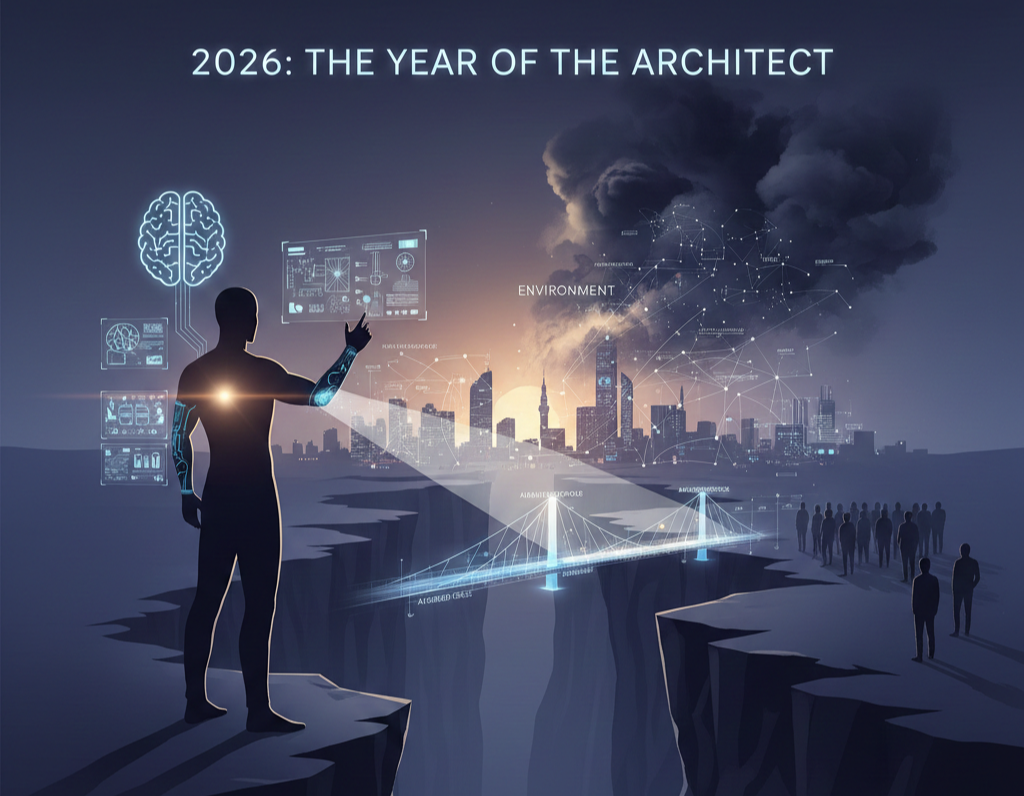
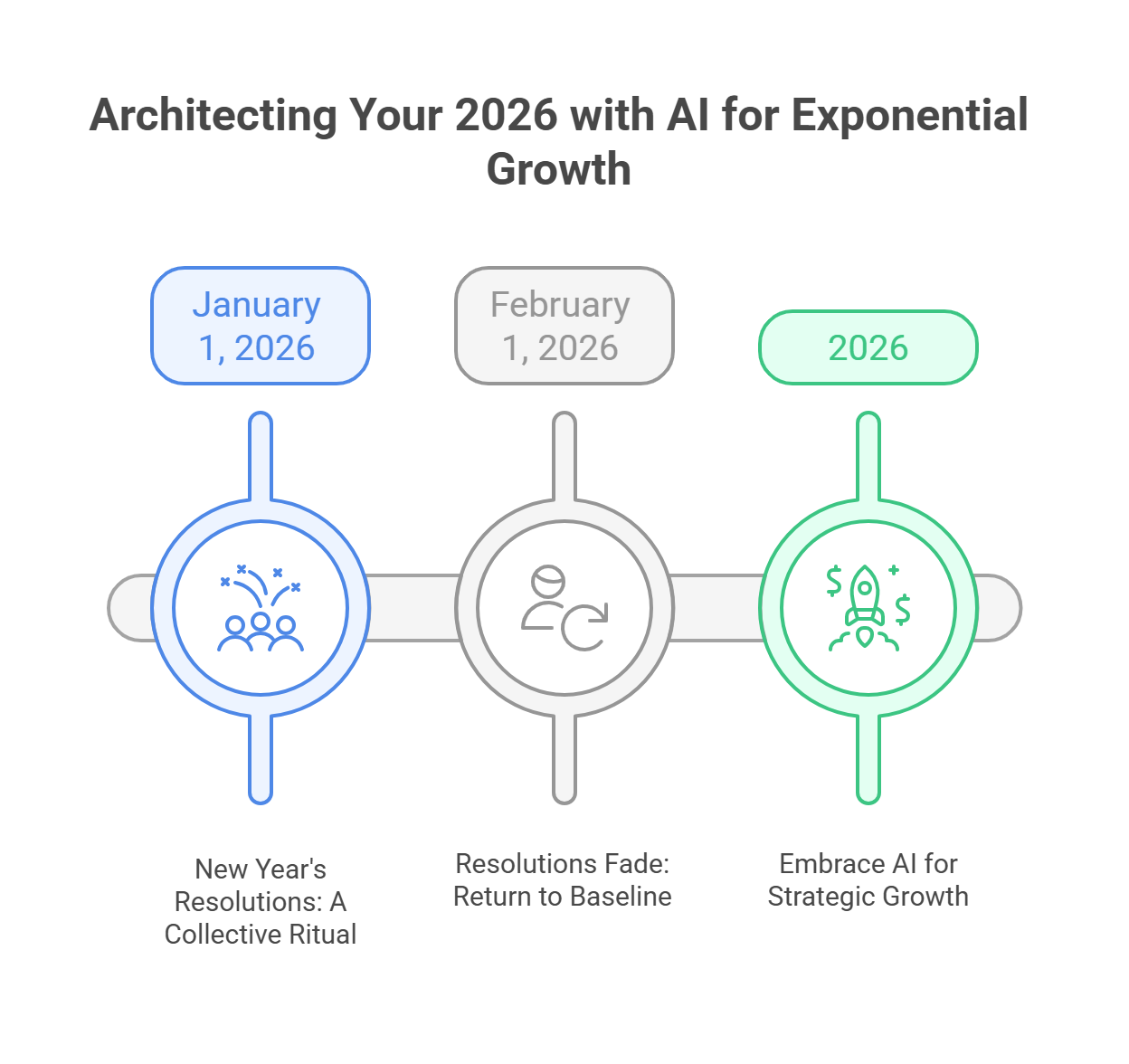
The transition from one year to the next is usually marked by a collective ritual of "vague dreaming." We call them New Year’s Resolutions, but in reality, they are often just emotional reactions to the guilt of December’s excesses. We promise to "be healthier," "work harder," or "be more present," yet by February, the gravitational pull of old habits and systemic friction—especially in high-pressure environments like Lebanon—drags us back to the baseline.
The problem is that traditional resolutions are built on linear thinking. They assume that a burst of January motivation can sustain a 365-day marathon. But we are no longer living in a linear world. As we enter 2026, we are operating in an era of exponential change driven by Artificial Intelligence.
The thesis for 2026 is simple: Don't resolve; architect. 2026 is the year we stop wishing for change and start engineering it. By moving beyond the "Intelligence Divide," we can leverage AI not merely as a chatbot to answer questions, but as a strategic co-pilot to define, track, and accelerate our evolution across three core pillars: Health, Impact, and Social Fitness. This is your blueprint for moving from passive survival to exponential growth.
Part 1: The AI Intelligence Divide & Why Resolutions Fail
To understand why your previous resolutions failed, we must look at their anatomy. Most are vague (lacking measurable outcomes), reactive (driven by temporary emotion), and feedback-poor (no system to tell you when you’ve veered off track). You cannot manage what you do not measure, and you cannot measure what you haven't defined with surgical precision.
The Failure of the "Human-Only" Feedback Loop
The unassisted human brain is a master of self-deception. When we set a goal like "be more successful," our brain lacks a clear definition of success. Without a constant data stream, we rely on "how we feel" on a Tuesday morning. If we feel tired, our resolution takes a backseat. This is a Linear Feedback Loop, and it is incredibly fragile.
Introducing the Personal AI Intelligence Divide
We have already discussed how AI is creating a chasm between those who use it to amplify their cognition and those who don't. Applying this to personal growth, the "augmented" individual treats their life like a high-performance startup.
Leveraging AI in your daily life inherently makes you more efficient, but more importantly, it makes you faster at problem-solving. This acceleration changes your relationship with your goals. You move from passive wishing to active, data-driven architecture. If AI can help a founder solve a complex architectural flaw in a software stack, it can certainly help you solve the "flaws" in your daily routine, your caloric intake, or your professional output.
The Mindset Shift: From Linear to Exponential
Traditional resolutions assume progress looks like a straight line. But AI-driven growth is exponential. It is based on iteration and optimization. In an exponential mindset, a "failure" isn't a reason to quit; it’s a data point that helps the system (you) recalibrate. This mindset is crucial for 2026. In an environment as volatile as Lebanon, a linear plan will break. An exponential, AI-augmented architecture will adapt.

Part 2: Pillar 1: Architecting Your Health Baseline
Health is the foundation of all impact. In a resource-constrained environment, your body is your only truly reliable piece of infrastructure. However, we must stop treating health as a "project" to be finished and start treating it as a Baseline to be maintained.
Beyond "Lose Weight": The 65 kg Philosophy
Take a concrete target, such as 65 kg. For many, this is a "destination." For the architect, it is a maintenance parameter. The specific number is less important than its maintenance and composition. We are reframing health from "losing weight" to "Maintaining optimal energy for peak cognitive performance."
If your weight fluctuates wildly, your energy fluctuates wildly. If your energy fluctuates, your ability to leverage AI and build your business in a high-stress environment collapses.
Systematizing Health with AI
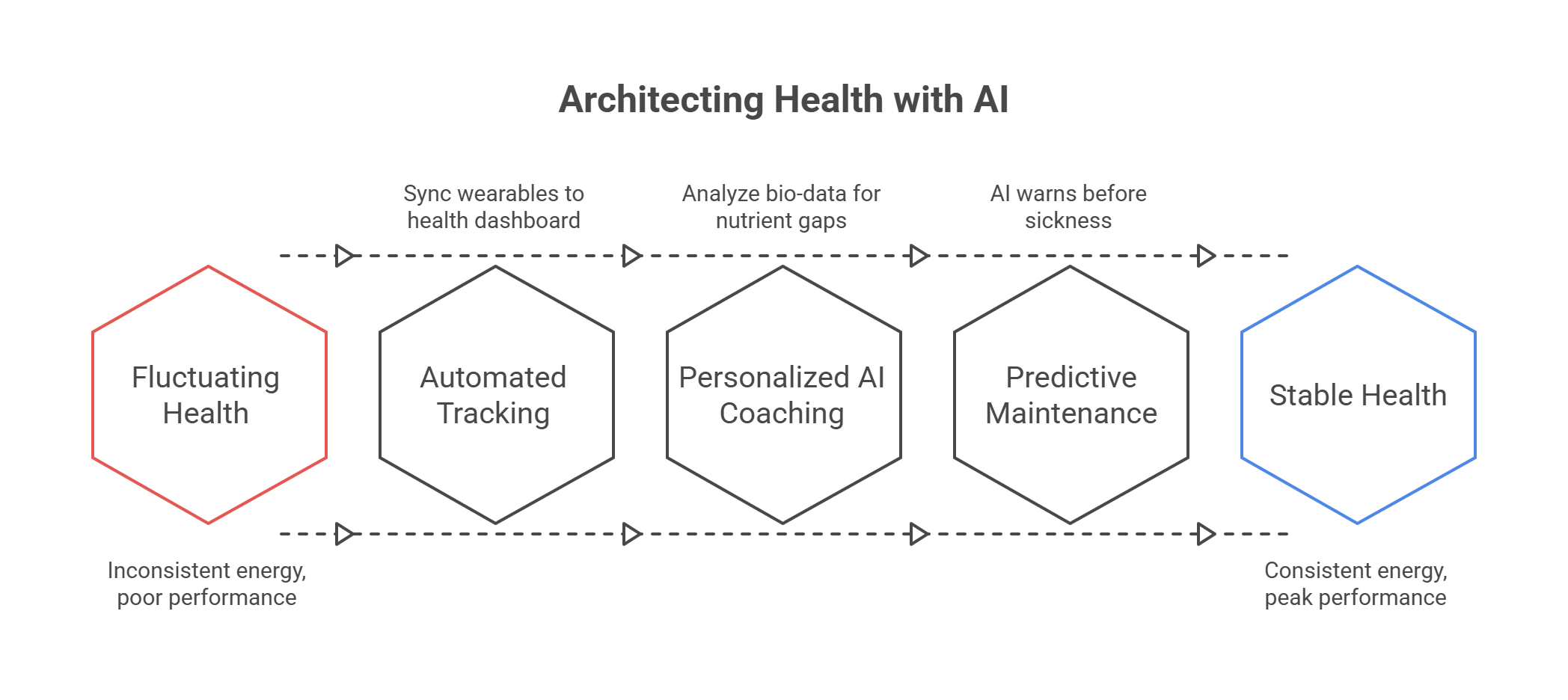
In 2026, we do not guess our health status. We architect a Real-Time Health Stack:
- Automated Tracking & Data Aggregation: Use AI-integrated smart scales and wearables (Whoop, Oura, or Garmin). These devices shouldn't just sit on your wrist; they should sync to a central "Health Dashboard." Tools like Gyroscope or Apple Health (enhanced by AI insights) can look for correlations between your sleep, your steps, and your focus levels.
- Personalized AI Coaching: Use LLMs to analyze your bio-data. You can export your nutrition logs from Cronometer and ask an AI: "Based on my last 30 days of data, identify the top three nutrients I am consistently lacking that correlate with my afternoon fatigue."
- Predictive Maintenance: AI can warn you before you get sick. By tracking HRV (Heart Rate Variability) and resting heart rate, AI can tell you: "Your recovery is at 30%. Today is not the day for a heavy lift. Opt for a 20-minute walk to preserve cognitive bandwidth for your afternoon meetings."
Defining your Health KPIs
To architect your health, you need measurable Key Performance Indicators:
- The Weight Stability KPI: "Maintain weight within +/- 1.5 kg of 65 kg for 48 out of 52 weeks."
- The Nutrient Consistency KPI: "Achieve 80% consistency in daily micro-nutrient targets, tracked via AI-linked nutrition apps."
- The Recovery KPI: "Average a Sleep Quality Score of 75+ for the entire year, using AI analysis to identify and eliminate 'sleep leakers' (late-night blue light, caffeine, etc.)."
Actionable Step: Pick one health objective and identify the AI-driven tracking system you will use to monitor it. Stop guessing; start measuring.
Part 3: Pillar 2: Amplifying Your Impact & Career
2026 is the year of Asymmetric Intelligence. For those of us using AI, our capacity to create value has become decoupled from our hours worked. If you are still setting career goals based on "working more hours," you are stuck in the 20th century.
Beyond "Productivity"
Productivity is doing things faster. Impact is creating more value. In a world of AI-driven efficiency, "being busy" is actually a sign of poor architecture. Your career goals should center on using AI as a force multiplier.
AI as Your Career Co-Pilot
We architect impact using the OKR (Objectives and Key Results) framework, but we use AI to refine it:
- The AI-Enhanced OKR: Instead of a vague goal like "grow my business," your AI-architected Objective might be: "Automate 60% of lead generation and initial outreach by Q3." You then ask the AI to break this down into three measurable Key Results (KRs) that are mathematically achievable.
- Workflow Automation via Agents: 2026 is the year of the AI Agent. We move beyond "chatting" to "delegating." Use tools like Zapier Central or AutoGPT to handle routine tasks—drafting emails, summarizing research, or basic code generation—freeing your brain for "High-Gain" strategic thinking.
- Hyper-Accelerated Skill Acquisition: The Intelligence Divide means you can learn faster than your competition. Use AI as a personalized tutor. If you need to master "Prompt Engineering" or "Data Analytics" for your 2026 goals, have the AI create a custom 30-day "Deep Dive" syllabus based on your current knowledge gaps.
Defining your Impact KPIs
- The Automation KPI: "Automate [X%] of routine administrative tasks by Q2, freeing up 15 hours per week for high-value strategic work."
- The Launch KPI: "Leverage AI-assisted coding/design to launch [Specific Project] by [Month] with a team of only [X] people (demonstrating 5x efficiency)."
- The Skill Acquisition KPI: "Achieve 'Level 4' proficiency in [New AI-related skill] by June, as verified by [Specific Project Output]."
Actionable Step: Define 1-2 career objectives. Identify which specific AI tools (e.g., Claude for strategy, Cursor for code, Perplexity for research) will act as your "Department Heads" for those goals.
Part 4: Pillar 3: Cultivating High-IQ Social & Emotional Fitness
The most dangerous side effect of the AI Intelligence Divide is Isolation. As you become more efficient and your cognitive processing speed increases, your patience for "low-bandwidth" human interaction will likely drop. In Lebanon, where the national conversation often revolves around shared grievances, the "Knowledge Gain" of a standard social evening can feel like zero.
The Objective: Develop "High-IQ Social Diplomacy"—the ability to connect effectively across cognitive paces without compromising your own growth.
AI as a Mirror for Emotional Intelligence (EQ)
We often think of AI as cold and logical, but it can be a profound tool for Self-Reflection:
- Pattern Recognition in Emotion: Use a voice-journaling app. Once a week, ask an AI to analyze your transcripts: "AI, look at my entries from this week. What are the recurring themes when I feel frustrated during social interactions? Am I displaying 'Cognitive Arrogance' or am I genuinely hitting a growth ceiling?"
- Strategic Communication: Use AI to prepare for high-stakes human moments. If you need to deliver a difficult message to a team member or a partner in a high-stress Lebanese context, ask AI to "stress-test" your script for empathy. "How might this message be perceived by someone who is currently in a 'Survival Timeline' mindset?"
- The Social Audit: Treat interactions as data points. After an important meeting, ask AI: "I felt I didn't connect with the board today. Here is the transcript of my points. How could I have simplified these complex AI insights to be more 'Human-Speed' and inspiring?"
Defining your Social/Emotional KPIs
- The "Horizontal Peer" KPI: "Establish and maintain a weekly deep-dive with a network of 3-5 'Horizontal Peers' (people who match or exceed my cognitive pace) to prevent intellectual burnout."
- The Active Listening KPI: "In 80% of personal/family interactions, practice 'Active Listening'—measured by my ability to summarize the other person’s emotional state before offering my own 'AI-speed' solution."
- The Empathy Research KPI: "Engage in one 'Low-Gain' social interaction per week specifically to observe human behavior, resilience, and UI/UX hurdles in the real world. Use this as 'Field Research' for my products."
Actionable Step: Identify one social relationship that feels "strained" by your pace. Use an AI to help you draft a strategy to re-connect on an emotional level rather than a logical one.

Conclusion: The Responsibility of the Architect
As we look toward 2026, the temptation is to get lost in the tools. We can become so obsessed with our wearables, our OKRs, and our AI agents that we forget the "Why."
AI is the co-pilot; you are the soul. The reason we architect our health is to have the energy to serve our families and our country. The reason we amplify our impact is to prove that Lebanon can be a hub of innovation despite the darkness. The reason we cultivate social fitness is because, at the end of the day, a bridge that only exists on one side is useless.
The "New Year" doesn't start because the calendar flipped. It starts because you decided to stop being a passenger in your own life. You have access to the most powerful cognitive amplification tools in human history. In 2026, the gap between the "Wishers" and the "Architects" will become an unbridgeable canyon.
The future doesn’t just happen; it is architected. Make 2026 the year you stop making excuses for your environment and start using technology to transcend it. Build your best self, one AI-amplified goal at a time.
Your 2026 Launch Checklist:
- Audit Your Stack: Which AI tools are you actually using for growth, and which are you just using for distraction?
- Set Your Baselines: What is your "65 kg" equivalent in Health, Career, and Social life?
- Define Your Feedback Loops: How will you know, every Friday, if you are on track?
- Find Your Tribe: Who are the 3 people who will keep you from being the "Lone Genius" in the room?